
Boom Chain #8
Price range: $26.00 through $110.00
If Corduroy is our attempt to combine coffees we think play well together as espresso, Boom Chain is our pursuit of tasty, loud, mostly fruit-forward coffees and combinations of coffees for filter brewing.
Some folks will tell you that blending—whether you’re talking coffee, or whisky, or wine, or another beverage—is an art form. And while it sounds a bit snooty to say it out loud, we get it. All of the blends in our lineup serve a particular purpose, with a general flavor profile that we try to keep consistent by blending different coffees over the course of the year. Taking this approach is a necessity, as green coffee is seasonal, with varying degrees of perishability. If you buy a years’ worth of beans for your blend in the hopes of keeping it perfectly consistent, come month 8, or 5, or sometimes even 3, the blend ends up dropping off in quality. Coffees age out, becoming woody or dirty in flavor, or sometimes just lose their pizzazz. And so we cup through coffee samples throughout the year in order to find fresh, sweet stock that serve the purposes we need them to.
Again, while our blending to this point has been purpose driven, with particular outcomes in mind, Boom Chain is the opposite. We see it as an exercise in experimental bombast and awesomeness, combining mostly fruit-forward, sometimes uniquely processed, coffees with volume knobs that go to 11. Like Corduroy, Boom Chain iterations will come and go, but they will always offer a big, flavorful cup.
Boom Chain #8 is a 50/50 combination of two natural process coffees with extended fermentations. The first is a natural from Bank Gotiti in Yirgacheffe, which on its own exhibits a kind of classic, purple-fruited and high toned cup. The second coffee is quite unique–a 96 hour anaerobically fermented coffee from Uganda, produced by Norman Mukuru. When we cupped it and decided to purchase it, we didn’t know it was anaerobic. We just knew we liked the fruit profile, as it showed dark fruits, along with mild chocolate and a bananas foster sort of thing. It was only when the bags showed up in our roastery that we saw the process label.
The two coffees combine for something truly unique. Some folks in the roastery think of the fruit as having a grape jelly vibe, but I think the grape flavor moves less toward jam, and more to wine. The flavor reminds me of syrah, with a dark red and light purple fruit profile, accompanied by minerals and a savory component. You might compare it to licorice. There’s also graham, dark chocolate, and a rind-y element like watermelon pith providing it structure and lift. It’s really delicious, in an “adult” sort of way.
—–
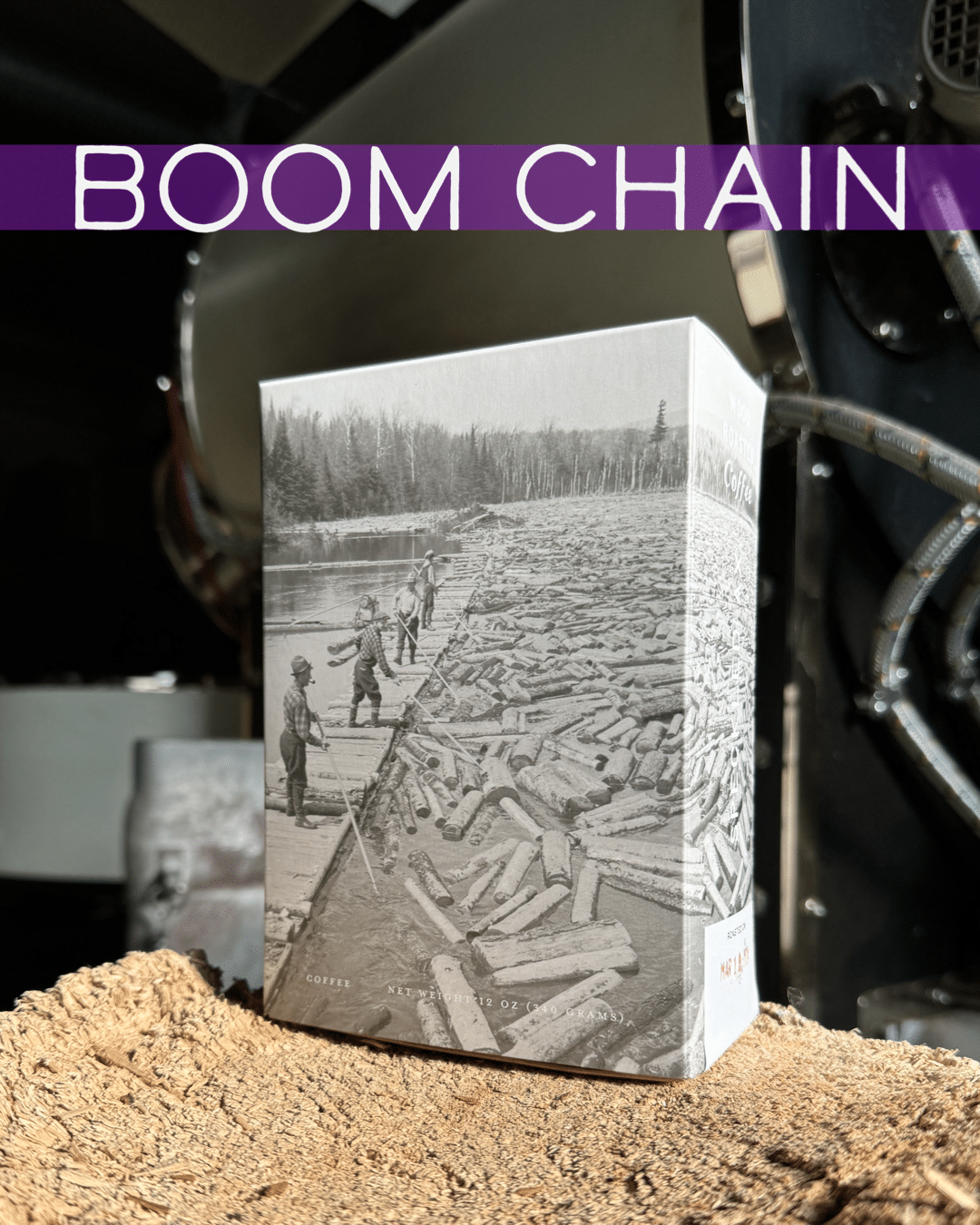
note on the series: in the days of long logging in Maine, loggers would use snowmelt and Maine’s extensive river system to float logs from the depths of the woods to civilizations and sawmills. At various stages of the river drive, as it was called, logs would need to be counted and sorted, as the property of numerous logging outfits mixed and mingled as the drive made its way south. This sorting was done at catch-alls called booms, which were themselves floating barriers comprised of logs, wood and chains extending across a water body. Boom Chain is our own seasonal “catch-all.”
- Location: Yirgacheffe, Ethiopia and Mt Elgon, Uganda
- Elevation: 1500-2200 MASL
- Varietal: heirloom, SL-14, SL-28
- Process: natural and anaerobic natural
ADDITIONAL INFORMATION
If Corduroy is our attempt to combine coffees we think play well together as espresso, Boom Chain is our pursuit of tasty, loud, mostly fruit-forward coffees and combinations of coffees for filter brewing.
Some folks will tell you that blending—whether you’re talking coffee, or whisky, or wine, or another beverage—is an art form. And while it sounds a bit snooty to say it out loud, we get it. All of the blends in our lineup serve a particular purpose, with a general flavor profile that we try to keep consistent by blending different coffees over the course of the year. Taking this approach is a necessity, as green coffee is seasonal, with varying degrees of perishability. If you buy a years’ worth of beans for your blend in the hopes of keeping it perfectly consistent, come month 8, or 5, or sometimes even 3, the blend ends up dropping off in quality. Coffees age out, becoming woody or dirty in flavor, or sometimes just lose their pizzazz. And so we cup through coffee samples throughout the year in order to find fresh, sweet stock that serve the purposes we need them to.
Again, while our blending to this point has been purpose driven, with particular outcomes in mind, Boom Chain is the opposite. We see it as an exercise in experimental bombast and awesomeness, combining mostly fruit-forward, sometimes uniquely processed, coffees with volume knobs that go to 11. Like Corduroy, Boom Chain iterations will come and go, but they will always offer a big, flavorful cup.
Boom Chain #8 is a 50/50 combination of two natural process coffees with extended fermentations. The first is a natural from Bank Gotiti in Yirgacheffe, which on its own exhibits a kind of classic, purple-fruited and high toned cup. The second coffee is quite unique–a 96 hour anaerobically fermented coffee from Uganda, produced by Norman Mukuru. When we cupped it and decided to purchase it, we didn’t know it was anaerobic. We just knew we liked the fruit profile, as it showed dark fruits, along with mild chocolate and a bananas foster sort of thing. It was only when the bags showed up in our roastery that we saw the process label.
The two coffees combine for something truly unique. Some folks in the roastery think of the fruit as having a grape jelly vibe, but I think the grape flavor moves less toward jam, and more to wine. The flavor reminds me of syrah, with a dark red and light purple fruit profile, accompanied by minerals and a savory component. You might compare it to licorice. There’s also graham, dark chocolate, and a rind-y element like watermelon pith providing it structure and lift. It’s really delicious, in an “adult” sort of way.
—–
note on the series: in the days of long logging in Maine, loggers would use snowmelt and Maine’s extensive river system to float logs from the depths of the woods to civilizations and sawmills. At various stages of the river drive, as it was called, logs would need to be counted and sorted, as the property of numerous logging outfits mixed and mingled as the drive made its way south. This sorting was done at catch-alls called booms, which were themselves floating barriers comprised of logs, wood and chains extending across a water body. Boom Chain is our own seasonal “catch-all.”
- Location: Yirgacheffe, Ethiopia and Mt Elgon, Uganda
- Elevation: 1500-2200 MASL
- Varietal: heirloom, SL-14, SL-28
- Process: natural and anaerobic natural